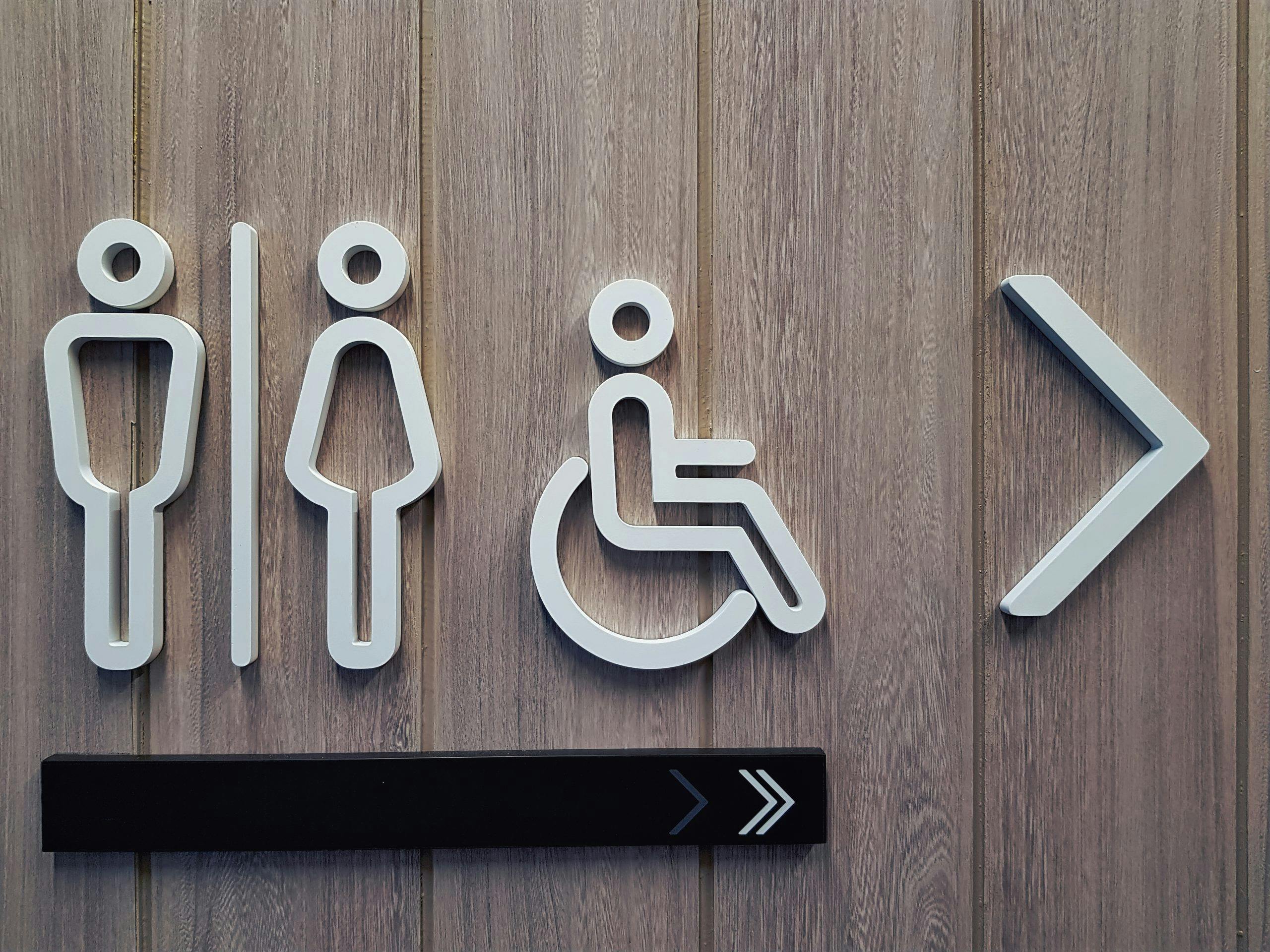
Disabled toilet regulations exist to ensure that toilet facilities are designed and installed in a way which makes them accessible to those with disabilities.
Being able to access toilet facilities is essential for everyone. However, some members of the public have additional needs. As a result, standard toilet layouts are not always suitable for people with limited mobility, sensory impairments or other disabilities.
For building owners, facilities managers and planning teams, keeping up to date with disabled toilet regulations is important to ensure equality, dignity and legal compliance.
While it is advisable to consult our professional accessible toilet installers for tailored advice, the following information outlines the key points to consider under current UK regulations and guidance at the time of writing in 2026.
Disabled Toilet Dimensions UK
The table below sets out the key dimensions for a unisex wheelchair accessible toilet under Approved Document M Volume 2 and BS 8300-2:2018. These figures are minimums. Building control may expect more generous space depending on the building type and how the toilet will be used.
Key disabled toilet dimensions (Approved Document M and BS 8300-2:2018)
- Minimum room size where other toilets are available: 1500mm wide x 2200mm deep
- Minimum room size where it is the only toilet in the building: 2000mm wide x 2200mm deep, to fit a standing height washbasin
- Wheelchair turning space: 1500mm x 1500mm, clear of fittings
- WC seat height: 480mm from finished floor level
- WC projection from rear wall: 750mm
- WC centre line from side wall: 500mm
- Drop-down support rail: 320mm from the WC centre line, 680mm high when lowered
- Horizontal grab rails: 680mm above finished floor level
- Washbasin rim height: 720mm to 740mm
- Door clear opening width: 800mm minimum, wider depending on approach
- Emergency pull cord: red cord with bangles at 100mm and 800mm to 1000mm above the floor
Examples Of Accessibility Needs To Consider
Disabilities come in many forms, with some common examples relating to amputation, arthritis, artificial limb usage, cerebral palsy, epilepsy, multiple sclerosis, musculoskeletal injuries, one sided paralysis, sight impairment, spina bifida and spinal cord injuries.
However, it is important to recognise that not all disabilities are visible. Therefore, when designing a toilet to accommodate those with disabilities, it's essential to think broadly about the different ways that someone may need additional help when using the toilet.
Types Of Disabled Toilet
Based on the different types of disabilities that exist, there are also different types of disabled toilets which can be installed.
Accessible Unisex Toilet
This is the most common type of accessible toilet. It is designed to let wheelchair users transfer safely from their chair to the WC, either independently or with help from a companion.
The minimum internal size is 1500mm wide by 2200mm deep. If the accessible toilet is the only toilet in the building, the width should increase to 2000mm so a standing height washbasin can be included.
Larger Accessible Toilet
In some settings, a larger accessible toilet may be provided to allow greater circulation space, carer assistance or use of mobility equipment. These layouts often allow transfer from either side of the toilet and may include a larger turning circle.
Ambulant Accessible Cubicle
Ambulant accessible cubicles are designed for people who can walk but need extra support, such as people using crutches or a walking stick. They sit within the male and female washrooms rather than in a separate room. Each one includes grab rails, a raised WC and an outward opening door.
An ambulant cubicle should be at least 800mm wide and is typically around 1500mm deep. Every single-sex washroom should include at least one.
Where a washroom has four or more cubicles, one should also be an enlarged cubicle at least 1200mm wide. This gives extra space to people who need it, such as parents with young children or people carrying luggage.
Since October 2024, detailed guidance on ambulant cubicle dimensions has sat within Approved Document T. Our guide to toilet cubicle sizes and disabled cubicle features covers these in more detail.
Features Common In Accessible Toilets
- Clear and visible signage, including tactile or braille where appropriate
- Slip resistant flooring
- Good colour contrast between walls, floors and fittings
- Adequate lighting with easily operated controls
- Outward opening or sliding door
- Sufficient clear door opening width to allow wheelchair access
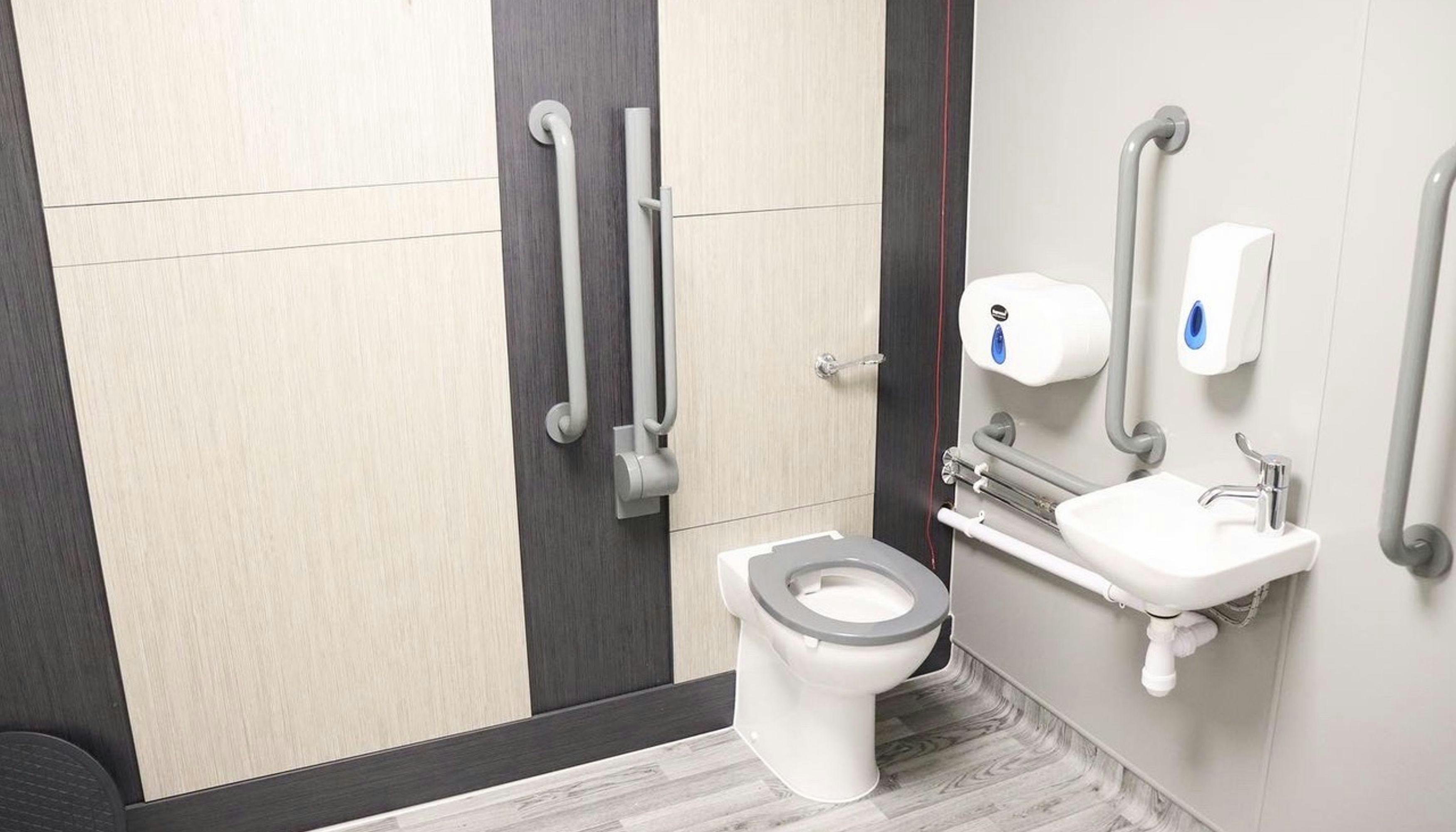
- Grab rails positioned to support safe transfer
- Accessible washbasin with lever or sensor taps
- Emergency assistance alarm with pull cord reaching the floor
UK Regulations And Guidance For Disabled Toilets
The Equality Act 2010 places a duty on service providers, employers and public bodies to make reasonable adjustments so that disabled people are not placed at a substantial disadvantage. This duty is ongoing and applies to physical features, policies and the way services are provided.
Design standards for toilets are primarily set out in Building Regulations Approved Document M and British Standard BS 8300. These documents provide practical guidance on layout, dimensions, fittings and circulation space for accessible sanitary facilities.
Compliance is usually assessed through building control as part of the design, construction or refurbishment process. The exact requirements depend on the building type, size and use.
Changing Places Toilets
Changing Places toilets are designed for people with more complex needs who require additional space and equipment, such as a ceiling mounted hoist and a height adjustable changing bench.
Under current Building Regulations guidance, Changing Places toilets are required in certain new public buildings and large extensions, including major shopping centres, transport hubs, hospitals, leisure facilities and large public venues. They are not required in every building, but must be provided where the criteria set out in Approved Document M are met.
Existing buildings are encouraged to provide Changing Places toilets where reasonably practicable, particularly where large numbers of people are expected to visit.
Disabled Toilet Layout

Most accessible toilets in the UK use a corner WC layout. The WC sits close to one wall, with its centre line 500mm from the side wall. This leaves clear space on the open side for a wheelchair user to pull alongside and transfer across.
A compliant layout should include:
- A drop-down support rail on the open side of the WC, with fixed horizontal and vertical rails on the adjacent wall
- A washbasin within reach of the WC seat, with the tap on the side nearest the WC
- A flush handle on the transfer side of the cistern
- A 1500mm x 1500mm turning space kept clear of fittings and bins
- An emergency pull cord that can be reached from the WC and from the floor, with a reset button within reach of the WC
- A mirror usable from both seated and standing positions
Where a building has more than one accessible toilet, the layouts should be handed. Offering both left and right transfer options means users can choose the side that suits them.
A good layout also considers privacy, ease of cleaning and room for a carer to assist where needed.
Disabled Toilet Door Size
The door to an accessible toilet should give an effective clear opening width of at least 800mm in a new building. Approved Document M sets wider minimums where the approach is tighter. For example, it requires 825mm where the door is approached at right angles from a corridor less than 1500mm wide.
The door should open outwards so it does not reduce the space inside and can be opened if someone has fallen against it. A horizontal closing bar should be fitted to the inside face. Locks should be operable with a closed fist and releasable from outside in an emergency.
Approved Document T
Approved Document T came into force in England on 1 October 2024. It applies to toilet accommodation in new buildings other than dwellings. A revised edition followed in November 2025 to correct minor errors, with no change to the guidance itself.
Approved Document T sets out how toilet provision should be arranged. Single-sex toilets should be provided first. Any remaining space can then be used for universal toilets. These are fully enclosed rooms for individual use, each with its own WC, washbasin and hand drying.
Universal Toilets Are Not Accessible Toilets
A common misunderstanding is that a universal toilet is the same as an accessible toilet. It is not. A universal toilet is designed for anyone who chooses to use it, but it is not designed for wheelchair users.
Guidance on wheelchair accessible toilets and Changing Places toilets remains in Approved Document M Volume 2. A building designed to Approved Document T must still meet Approved Document M for wheelchair accessible provision.
Ambulant And Enlarged Cubicles
Approved Document T now contains the detailed guidance on ambulant toilet accommodation. This covers both ambulant cubicles within single-sex washrooms and the fully enclosed ambulant universal toilet, which the document classes as Type A.
The key rules for most commercial washrooms are:
- Every single-sex washroom should include at least one ambulant cubicle.
- Where four or more cubicles are provided, one of them should be an enlarged cubicle at least 1200mm wide.
Examples Of What To Include In A Design Plan - Disabled Sanitary Ware & Other Key Features

WC Pans And Seats
- Back-to-wall or wall-hung WC pans set at 480-500mm seat height
- Raised toilet seats (removable, for additional height where needed)
- Soft-close toilet seats with ergonomic open-front design
- Doc M WC pans (part of integrated Doc M pack sets)
Grab Rails And Support
- Horizontal stainless steel or nylon-coated grab rails fixed to side walls
- Drop-down (hinged) grab rails alongside the WC for transfer support
- Angled grab rails for additional postural support
- Grab rails beside basins for stability when hand washing
Basins And Taps
- Shallow-depth wall-hung basins allowing wheelchair knee recess underneath
- Lever-operated or sensor-operated taps to avoid twisting or gripping
- Thermostatic tap cartridges to prevent scalding
- Extended lever handles for ease of operation with limited dexterity
Cisterns And Flushing
- Large paddle or lever flush handles
- Dual-flush push plates with extended or recessed actuation
- Concealed cisterns to maximise clear wall space for grab rails
Soap Dispensers And Accessories
- Lever or push-operated soap dispensers at accessible heights
- Recessed or surface-mounted toilet roll holders within easy reach of the WC
- Fold-down padded shower or changing seats
- Shelf or worktop surface for stoma or catheter management
Showering (Where Provided)
- Level-access or zero-threshold shower trays
- Fold-down shower seats at 480mm-500mm height
- Thermostatic bar shower valves with lever controls
- Handheld shower heads on adjustable slide rails
Emergency And Safety
- Emergency pull cord alarm systems with floor-level red triangle
- Alarm reset buttons positioned at low level
- Contrast coloured fittings against walls and floors for visual impairment
- Non-slip flooring and anti-slip coating on seats and surfaces
Mirrors And Vanity
- Full-height or tilted mirrors usable from both seated and standing positions
- Lowered vanity counters and mirrors for wheelchair users
Disabled Toilets FAQs

As leading UK installers of disabled toilets and washroom facilities, we’re here to answer any questions you may have about disabled toilet regulations in the UK, which may apply for the toilets found in your business or public building.
For any further questions or to get a free quote for a disabled toilet installation, please call us on 0115 811 4242.
What Is A Disabled Toilet Called?
‘Disabled toilets’ is the term that most people are familiar with when referring to toilets for the disabled. However, as professional installers, we actually go by the term accessible toilets.
We know that getting the terminology right isn’t easy. Since many people still actively search for ‘disabled toilets’, both when trying to locate them or even to have them installed in their commercial building, we optimise our service pages to include this term. Plus, similar terms relating to making toilets more accessible.
Is It Illegal To Use A Disabled Toilet UK?
There are no laws surrounding who can use disabled toilets. In theory, this means that anyone, regardless of whether they consider themselves disabled or not, can use a designated disabled toilet. However, it is far from ideal when someone cannot access the features they require within a disabled toilet because it is occupied.
From our experience as washroom installers, a common problem is when a venue doesn’t provide enough toilets to meet its footfall demands. As a result, patrons are more likely to use a disabled toilet instead, especially if there are long queues and users are unable to wait a long time.
For this reason, all businesses should factor in footfall levels when designing toilets for customers or employees.
What Height Is A Disabled Toilet?
Under BS 8300:2018 and Building Regulations Approved Document M, the WC pan in an accessible toilet should be set at a height of 480mm to 500mm from finished floor level to the top of the seat.
The required disabled toilet height is slightly higher than a standard domestic toilet, which typically sits at around 400mm.
This raised height makes it significantly easier for wheelchair users, older people, and those with limited leg strength or joint conditions to lower themselves onto and rise from the seat without excessive strain.
What Is The Minimum Size For A Disabled Toilet?
Under UK Building Regulations Approved Document M and BS 8300:2018, a standard unisex wheelchair accessible toilet should have a minimum floor area of 2200mm x 1500mm.
These dimensions are minimum thresholds rather than targets, and larger provision is always encouraged to ensure genuinely comfortable and safe use.
Similarly, these regulations also offer guidance on an appropriate disabled door width. The minimum clear opening width for a doorway into a wheelchair accessible toilet is 800mm, though 825mm is the preferred minimum to comfortably accommodate a standard wheelchair.
Doors to disabled toilets should be outward opening or sliding to prevent a fallen user from being trapped behind the door. They should be operable with a closed fist or a single hand to accommodate users with limited grip or dexterity.
Approved Document M sets a maximum opening force of 30N at the leading edge of the door from closed to 30° open, and 22.5N from 30° to 60°.
What does ambulant disabled mean?
Ambulant disabled describes people who have a disability or mobility impairment but can still walk, often with the help of a stick, crutches or a walking frame. Unlike wheelchair users, they do not need a fully accessible WC, but they do need extra space and support to use the toilet safely and independently.
In washroom design, this is addressed with an ambulant disabled cubicle. These should be at least 800mm wide, with an outward opening door, grab rails on both sides and a raised WC pan. Every single-sex washroom should include at least one ambulant cubicle, and where there are four or more cubicles, one should also be an enlarged cubicle at least 1200mm wide.
What Are The Disabled Toilet Alarm Regulations UK?
The disabled toilet alarms regulations relate to Building Regulations Approved Document M (Access to and Use of Buildings).
As part of the requirements, disabled toilets must be fitted with an emergency assistance alarm system. Toilets must also have a pull cord that reaches to floor level (typically with a red triangle or similar indicator) along with an alarm reset button positioned at a height reachable from the floor. The cord must hang to within 100mm of the floor so that a person who has fallen and cannot rise can still activate it.
Additional guidance is provided by British Standard BS 8300:2018. The documents provide detailed technical guidance on alarm positioning, activation force and audible and visual alert outputs.
What Is The Disabled Toilet Key Scheme (Radar)?
The Radar Key Scheme, officially known as the National Key Scheme (NKS), is a UK wide system that allows disabled people to access locked public toilets independently using a single standardised key.
How the scheme works is that all participating toilets use the same standard lock. Eligible disabled people can obtain a single key that opens any NKS-fitted toilet across the country. Over 9,000 toilets are currently part of the scheme.
Anyone who needs a disabled toilet key (a Radar key) can purchase one from Disability Rights UK.
What Are The DDA WC Dimensions?
Under Building Regulations Approved Document M, a DDA compliant WC should measure at least 1500mm x 2200mm, providing enough space for wheelchair users to transfer safely onto the pan.
BS 8300 recommends a clear space of 1500mm x 1500mm in front of the WC where layout allows.
Door openings should offer a minimum clear width of 800mm, and grab rails, alarm cords and appropriate fittings must be positioned to support independent use.
What Are Disability Toilets?
Disability toilets are washroom facilities specifically designed and fitted out to meet the needs of people with disabilities, including wheelchair users. They feature wider door openings, grab rails, lowered wash basins and emergency alarm pull cords, along with sufficient floor space for manoeuvring.
In the UK, disability toilets (also known as disabled toilets) must comply with Building Regulations Approved Document M and BS 8300 to ensure safe, independent use.
Disabled Toilet Installation UK - Get A Free Quote From Inspired Washrooms
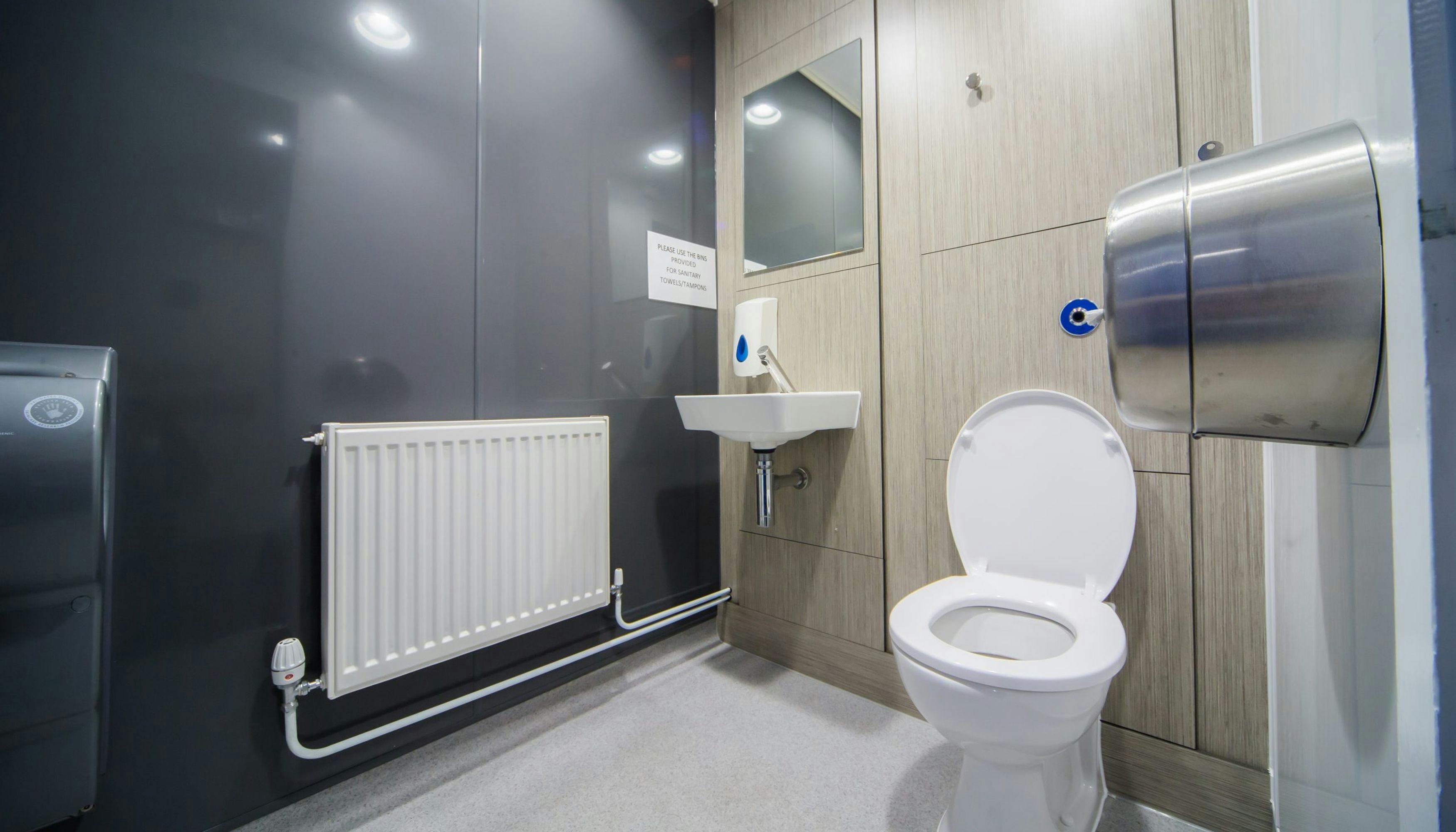
If you want to ensure that your building meets the needs of those with accessibility needs, then you're in the right place.
Inspired Washrooms installs disabled or accessibility-friendly toilets and washrooms right across the UK. Some of the environments we install in include hospitals, schools, restaurants and public buildings.
Interested in starting a project with us? Download our Inspired Washrooms Brochure to view our full range of products and services.
For a free quote please get in touch or call us on 0115 811 4242.