School Toilet Refurbishment -UK Nationwide Service

A school toilet refurbishment involves replacing and updating the sanitaryware, cubicles, flooring and wall finishes within a school's existing toilet facilities. Work typically includes new toilets, basins and cubicles sized for the relevant age group, along with hygiene focused upgrades such as sensor taps and touch free flushes, plus accessible facilities that meet current regulations. Projects are usually completed in 3 to 4 weeks and scheduled around school holidays to avoid disrupting term time.

short hero image

School Toilets & Washrooms for All Educational Key Stages

The right school washroom looks very different in a nursery than it does in a sixth form college. Pupil height, independence, privacy needs and safeguarding requirements all change as children move through the key stages, so every toilet refurbishment should be planned around the age group using it. Below is how school toilet design is adapted at each stage of education.

Nursery and Early Years Toilets (EYFS)

Children aged 3 to 5 are still learning to use the toilet independently, so facilities need to be low level, easy to reach and simple to supervise. Junior height pans and basins, low or half-height cubicle partitions and doors without locks allow staff to assist quickly while still giving children a sense of privacy. The DfE suggests around one toilet and washbasin for every 10 pupils under 5, with hot water to basins limited to 43°C to prevent scalding. Changing areas for nappies and accidents should sit close to the main washroom.

Primary School Toilets (Key Stages 1 and 2)

Primary school toilets need to cater for a wide range of ages and heights, from 5-year-olds in Year 1 to 11-year-olds in Year 6. Toilet cubicles for schools at this stage are usually scaled to child height, with robust, easy-to-clean surfaces and child-friendly locks that staff can open from the outside if needed. Separate toilets for boys and girls are required from age 8, so Key Stage 2 washrooms must be planned as single-sex or as fully enclosed, lockable single rooms. The DfE suggests one toilet and basin per 20 pupils aged 5 to 11.

Secondary School Washrooms (Key Stages 3 and 4)

For pupils aged 11 to 16, privacy and safeguarding become the main priorities. Full-height cubicles and doors reduce the risk of bullying and vandalism, while vandal-resistant materials, concealed plumbing and durable fixings help secondary school washrooms withstand heavy daily use. Under KCSIE 2026, toilets must be provided as single-sex facilities by biological sex, with self-contained lockable toilets offered as an alternative where needed. Layouts should also allow informal staff supervision from corridors without compromising privacy and changing rooms with showers are required for pupils taking PE.

Sixth Form, College and Further Education Washrooms

Post-16 students expect facilities closer to a modern commercial washroom than a traditional school toilet. Full-height cubicles, vanity units, wall-hung sanitaryware and good lighting create a more adult environment that encourages students to respect the space. Sixth forms within schools still fall under the school premises requirements, while standalone colleges are typically designed around workplace and Building Regulations standards. Accessible toilets, ambulant cubicles and sanitary disposal should be included throughout. Higher footfall between lessons means durable, low-maintenance finishes remain important, which is why many colleges prioritise toilet refurbishments that combine adult-style design with hard-wearing materials.


What Does A School Toilet Refurbishment Include?

A school toilet refurbishment is the process of replacing and updating the sanitaryware, cubicles, flooring and wall finishes in a school's existing toilet facilities, rather than building new ones from scratch.

It typically covers sanitaryware such as toilets, urinals and basins, along with cubicles, which are often replaced with bespoke systems sized appropriately for the age group. For instance, using child height fittings for primary schools and more robust, anti vandal specifications for secondary schools.

Flooring and wall finishes are usually upgraded to durable, easy to clean materials, and fixtures such as sensor taps, touch free flushes and hand dryers are commonly added to improve hygiene. Accessible facilities are also included to ensure compliance with the Equality Act 2010 and Building Regulations Part M.

Projects are usually scheduled during school holidays to avoid disrupting term time and take around 3 to 4 weeks depending on the scale of the work.

In England, schools also have specific legal requirements to meet as part of a refurbishment. For example, separate toilets for boys and girls are required from age 8 under the School Premises (England) Regulations 2012, and at least one accessible toilet must be provided under the Equality Act.


When Is A School Toilet Refurbishment Necessary?

✅ - Fixtures and fittings are showing significant wear, damage or repeated faults

✅ - Sanitaryware is nearing the end of its typical 10 to 15 year lifespan

✅ - Ongoing maintenance costs are becoming frequent or excessive

✅ - Flooring, walls or cubicles look tired, stained or are difficult to keep clean

✅ - Facilities no longer meet current accessibility requirements under the Equality Act 2010

✅ - The school no longer meets separate toilet requirements for boys and girls from age 8, as set out in the School Premises (England) Regulations 2012

✅ - Ventilation, lighting or hygiene provisions are outdated or insufficient

✅ - Vandalism is a recurring issue that better materials and fittings could help prevent

✅ - Pupil numbers have grown and the current facilities are undersized for demand

✅ - The school is undergoing wider building works and wants to update washrooms at the same time

P.S. Do you have any other issues that you’d like us to address? Please get in touch with our refurbishment team to discuss the condition of your school toilets. We’d be happy to provide any help or advice!


image

School Toilet Design Service

When designing your school toilets, our team will work with you to create your desired space, utilising high-quality materials and resources.

Our team of designers are also aware of all the user-friendly functions needed for a school setting. By introducing essential features for a school washroom such as auto-stop taps, toilet cubicles, IPS units, touch-less flushes and spacious vanity units, our school toilet designs provide a safe, hygienic place for students, staff and visitors.

Inspired Washrooms also have access to a wide range of colour schemes, splash mirrors and finishing details to make the space unique to your school and community.

Our UK nationwide refurbishment for school toilets includes locations such as Birmingham, Nottingham, Derby, Sheffield, Leicester and London.

Get in touch on 0115 811 4242 and one of our friendly team members will get your next school toilet project started!

image

Bespoke School Toilet Cubicles

Bespoke school cubicles are designed and manufactured to fit the exact dimensions, requirements and character of your school's washroom spaces. Unlike off-the-shelf solutions, a bespoke cubicle system allows you to specify the height, configuration, materials, colours and locking mechanisms that work best for your pupils and staff.

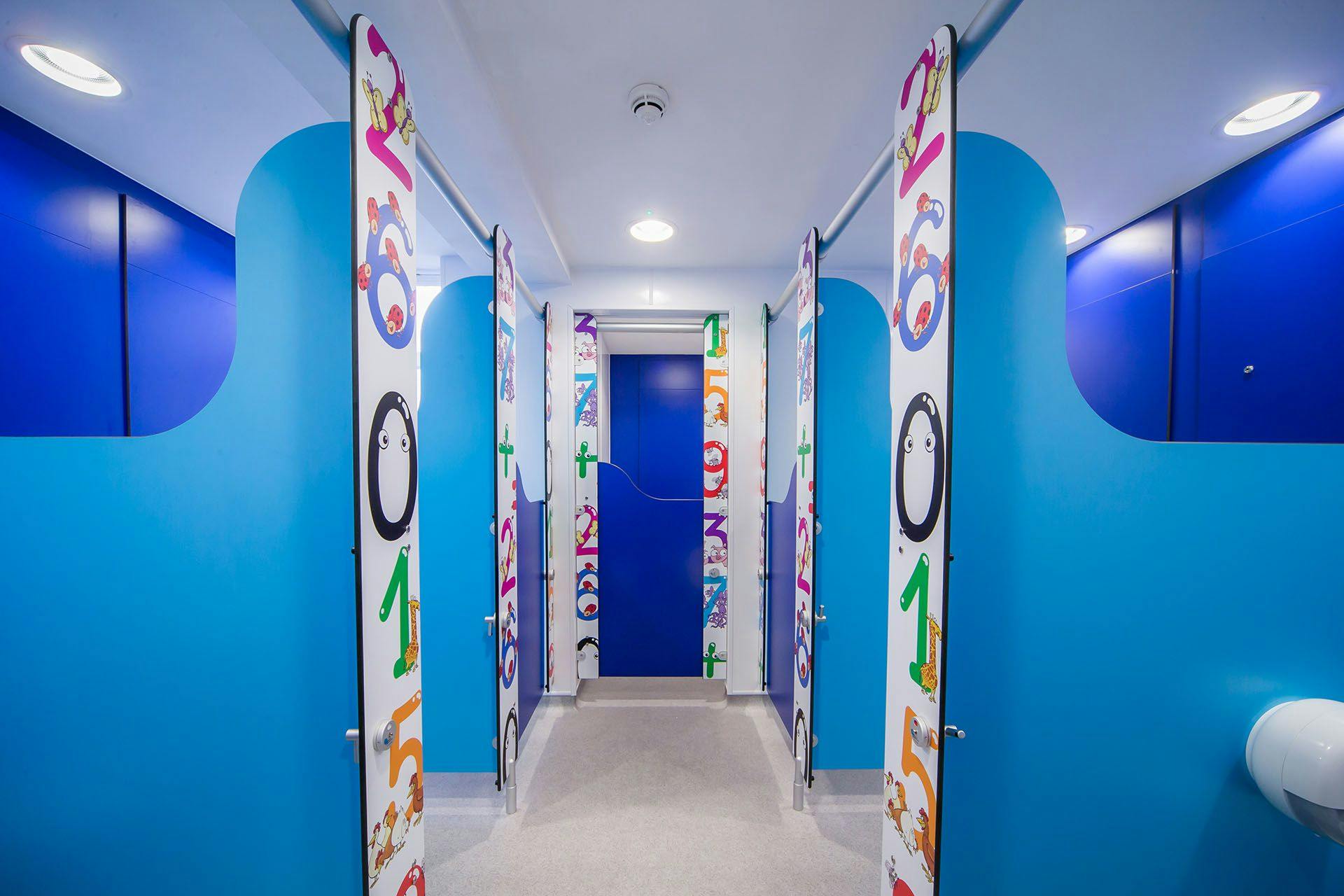
In a primary school environment, cubicles can be designed at child-friendly heights with emergency-access locks and bright, engaging colour schemes that help younger pupils feel at ease.

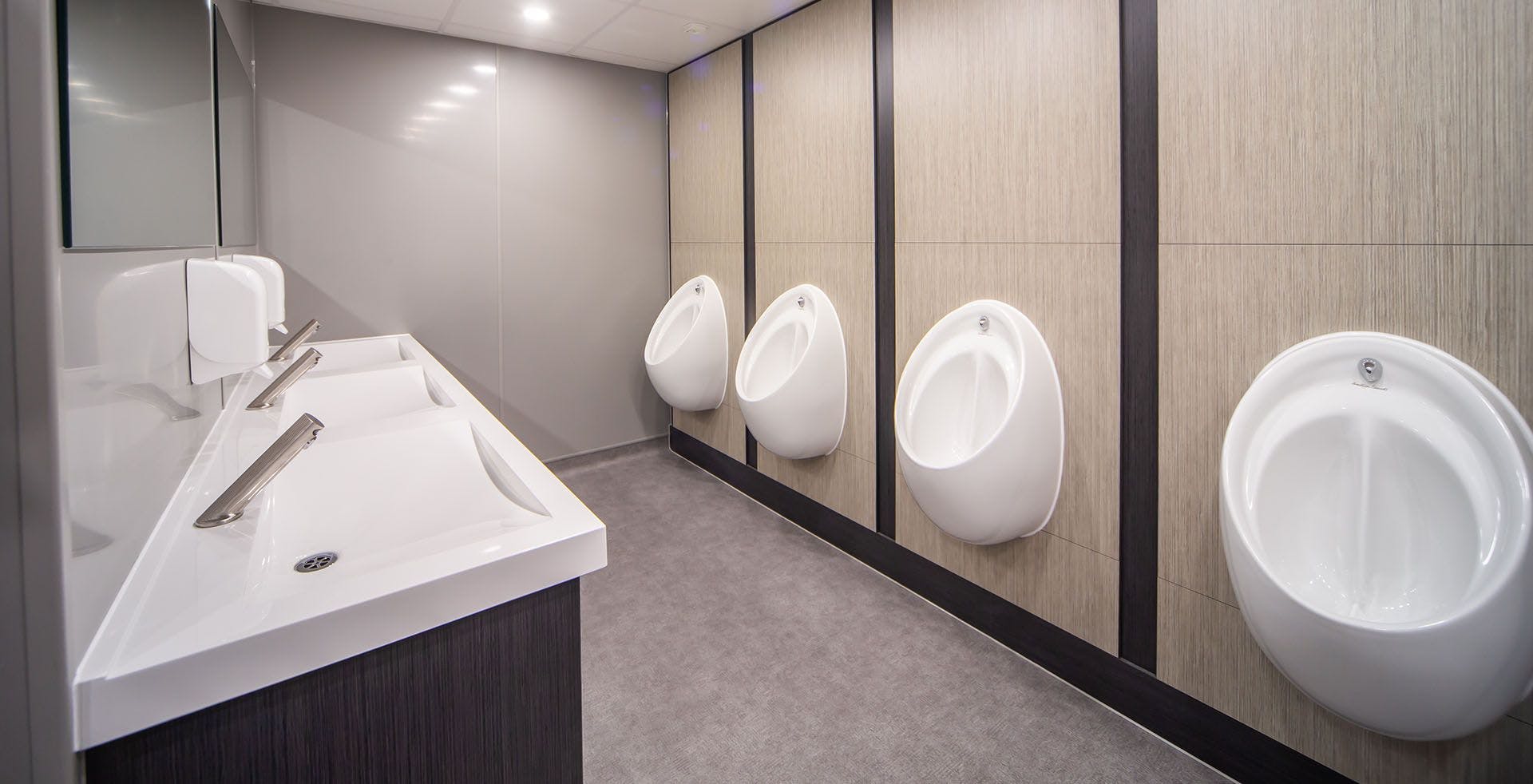
For secondary schools and colleges, a more robust specification is typically required, with anti-vandal laminate panels, concealed fixings and solid-grade laminate doors that withstand heavy daily use.

Accessible cubicles can be fully integrated into a bespoke layout from the outset, ensuring compliance with Building Regulations Part M without compromising the overall design.

Every cubicle is planned, manufactured and installed to your precise requirements, giving you a finished washroom that is safe, durable and built to last.

image

School Toilet & Washroom Refurbishments - Why Choose Inspired Washrooms?

At Inspired Washrooms, we schedule every refurbishment project well in advance to run during school holidays, so term time teaching is never disrupted.

All of our fitting staff are DBS checked, giving schools peace of mind when work is carried out with pupils on site.

We also offer an extended care and maintenance package, giving you fast access to our fitting team after handover for issues such as blocked toilets or fixture damage.

IPS Systems, Units & Panels

We offer IPS (Integrated Plumbing Systems) for sinks, toilets and urinals.

Learn more >

School Cubicles

Our School Toilet Cubicles are custom-configured, allowing you to ensure that they fit your exact needs and the needs of the children at your school.

Learn more >

Vanity Units

Our commercial vanity units are designed to fit into any design, space and environment, made with high-quality materials and fixtures that will withstand daily use.

Learn more >

image

Serving schools across the

UK

With a combined experience of over 40 years, our priority is to provide a turn-key service, allowing you to confirm your designs and then relax and leave us to complete the work, on time and on budget.

School Washrooms FAQs


Considering undertaking a school toilet refurbishment? We’ve answered some of the top questions below. If you don’t see your query or need more information, please give us a call on 0115 811 4242.

How Many Toilets Per Person In A School (UK)?

Under the School Premises (England) Regulations 2012, the minimum is:

  • Pupils under 5: 1 toilet and 1 washbasin per 10 pupils
  • Pupils aged 5 and over: 1 toilet and 1 washbasin per 20 pupils (rounded up)
  • Special schools: 1 toilet per 10 pupils, regardless of age

Other requirements:

  • Separate facilities for boys and girls aged 8 and over, unless the toilet is in a lockable room intended for one pupil at a time
  • Staff toilets must be separate from pupil toilets (they can be shared with visitors)
  • Suitable changing and toilet facilities for disabled pupils must be provided, in line with the Equality Act 2010

The DfE's non-statutory guidance (Toilets in schools and Building Bulletin standards) often recommends more generous provision than these legal minimums.

It’s also important to note that Wales and Scotland have their own school premises regulations, so ratios can differ there. The Inspired Washrooms team can provide tailored advice when you get in touch.

Can Schools Install Gender-Neutral Or Unisex Toilets?

Only as fully enclosed single rooms. The DfE advises that where there is unisex provision, the privacy of the occupant needs to be ensured and this will be achieved by, for example, having adequate enclosure and a full height door.

Where Should School Toilets Be Located?

The DfE says toilets should be planned so that hand washing facilities are provided within or in the immediate vicinity of every toilet; the rooms containing them are adequately ventilated and lit; they are located in areas around the school that provide easy access for pupils and allow for informal supervision by staff, without compromising pupils' privacy.

How Can Secondary Schools Prevent Vandalism In Toilets?


It can take a combined approach involving teachers and pupils to reduce and prevent vandalism in school toilets.

At Inspired Washrooms, we can also install anti-vandal measures for your school toilets to ensure your school toilets remain a pleasant environment for students. Some of the top ideas include vandal-resistant sensor taps, concealed trap urinals and anti-graffiti surfaces.

If your school toilets have previously been vandalised, speak to our experts about the ways in which we can combat the issue from a design perspective.

Do Schools Need To Have Disabled Toilets?

Yes, schools are required to provide disabled toilet facilities as per Education (School Premises) Regulations 1999 and the Equality Act 2010.

These facilities must include adequate space and grab rails. In some cases, specialised equipment like hoists or changing benches is also required to ensure dignity and inclusion.

Inspired Washrooms specialises in disabled (accessible) toilet installation, including for schools.

If you are unsure of the requirements or need to include a disabled toilet installation as part of your school toilet refurbishment project, please contact us to find out more.

How Often Should School Toilets Be Replaced?

School toilets are subject to heavy use and so will likely require replacement every 10-15 years. Although some elements, such as sanitaryware, can last for up to 25 years, the likes of taps, flooring, walls and cubicle doors can degrade faster.

What’s most important is not to focus solely on the age of your school toilets, but rather their condition. If your school toilets require constant maintenance or their general condition is letting your school down, a refurbishment is likely long overdue.

How Long Does It Take To Refurbish School Toilets?

The typical timeframe for refurbishing school toilets is 3-4 weeks. However, the exact time will very much depend on the number of toilets to be installed and the overall scale of work required.

At Inspired Washrooms, we’ll provide you with a more solid timeline once we’ve visited your school and created a project brief. In particular, we know that minimising disruption to pupils is important to our clients in the education sector. Rest assured, we’ll work with you to outline timeframes and align with your wider requirements as a school so that you’ll always be kept in the loop.

How To Plan New School Toilets Around Term Time?

Arranging for your school toilets to be refurbished during the school holidays is ideal to minimise disruption to pupils. However, depending on the number of toilet facilities your school has, it may still be possible to carry out the installation during term time.

In any case, we recommend scheduling your school toilet refurbishment as soon as possible with our team to secure your preferred timeframe.

Do Schools Need Changing Rooms And Showers?

Yes for older pupils. Suitable changing accommodation and showers must be provided for pupils aged 11 years or over at the start of the school year who receive physical education. Changing rooms at primary schools are optional.

Do Schools Have To Let Pupils Use The Toilet During Lessons?

There are no official government rules on whether pupils should be allowed to use the toilet during lesson time. Instead, it is up to the school to decide what their rules are. That said, the government has said all schools must be mindful of their duty of care and responsibilities to pupils. This includes ensuring that individual circumstances are fully considered, and any health issues are fully taken into account.

Can Staff And Pupils Share Toilets?

No, apart from accessible toilets. Staff toilets should be separate from those provided for pupils, except where they are designed for use by those who are disabled. Accessible facilities for pupils can also be used by staff and visitors. Staff provision is governed by Regulations 20 and 21 of the Workplace (Health, Safety and Welfare) Regulations 1992.

How Can Schools Make Toilets Less Intimidating For Younger Children?


If you’ve taken a look at our case studies page, then you’ll know we are huge fans of colourful school toilet renovations here at Inspired Washrooms!

The use of colourful tones is a fantastic way to put pupils at ease within school toilet areas. The exact colours can also be chosen with your school branding in mind.

Also, it’s common for school toilets to feel intimidating because they feel ‘too big’. To combat this, our school toilets feature child height toilets and basins so that everything is within easy reach. An age appropriate design is important as it supports independence and dignity.

For children with sensory sensitivities, we can also install measures such as quieter hand dryers, acoustic panels and soft close toilet seats.